



The key takeaways from JICMAIL’s Q1 2026 results

The key takeaways from JICMAIL’s Q1 2026 results
JICMAIL’s Q1 2026 update1 reinforces mail’s growing role in today’s customer journeys. As behaviours shift, the latest results show how the channel is evolving.
The main takeaway? Further proof of mail’s role as a Super Touchpoint, combining high attention, strong engagement, and increasing digital outcomes.
For marketers and advertisers, this is big news: mail is playing a more dynamic role in digital customer journeys than ever before.
Mail’s digital impact
One clear trend from JICMAIL’s latest numbers is the rise in digital engagement triggered by mail. In Q1 2026, more people used mail as a pathway to go online. Website visits prompted by mail reached 9.4%, a record for the first quarter and up from 8.7% in Q1 2025. Meanwhile, account look-ups, web searches, and app downloads all saw year-on-year increases, reinforcing mail’s role as a measurable driver of digital actions.
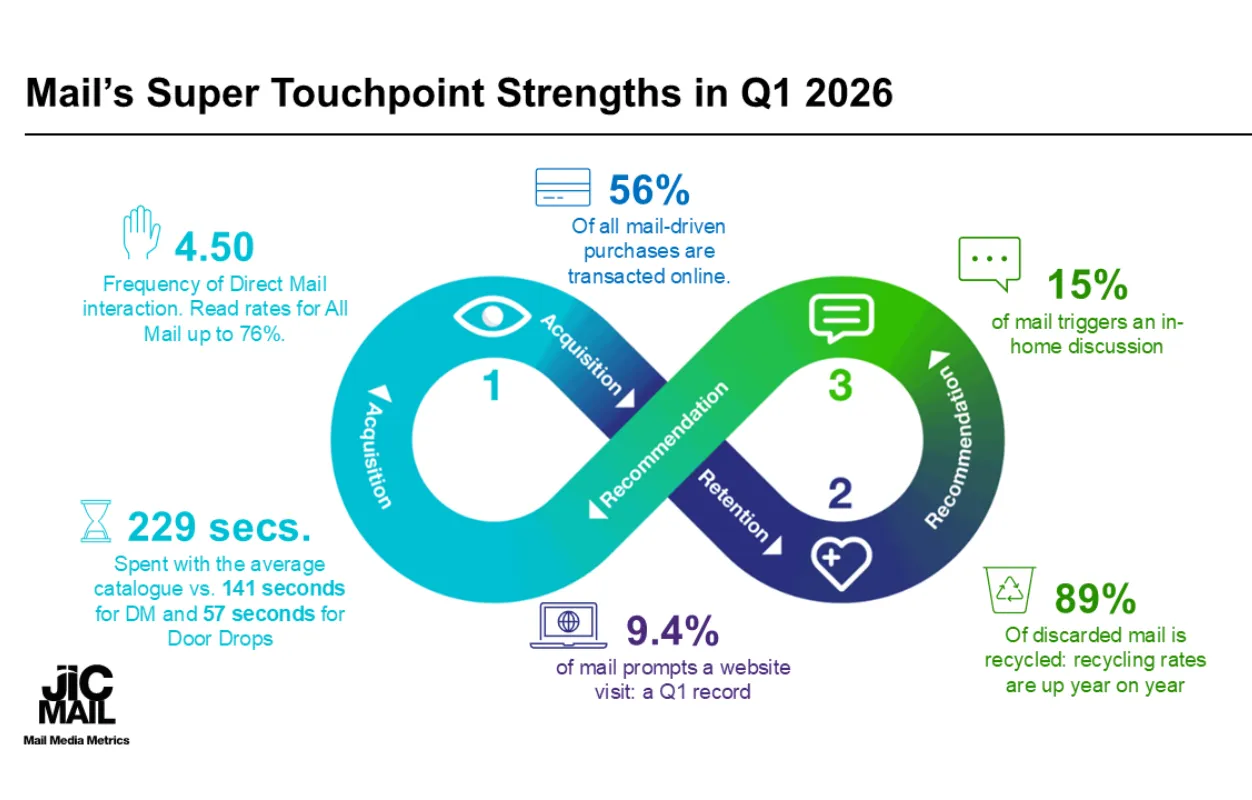
In addition, 56% of purchases resulting from mail were completed online, marking the highest level since tracking began and an increase from 53% in Q1 2025. This demonstrates mail’s strength in driving real online behaviour and making it a smart choice for digital marketers.
Mail as a Super Touchpoint
Mail’s real strength lies in its ability to act as a ‘Super Touchpoint’, blending its physical presence with digital prompts. The Q1 2026 results show that people are more likely to interact online after receiving mail, particularly when it’s integrated with other channels.
This hybrid approach isn’t just a passing trend; it’s a tried-and-tested way to boost engagement and conversion rates. This is supported by the fact that mail items in Q1 2026 achieved average attention times of 141 seconds for Direct Mail and 182 seconds for Business Mail, highlighting strong engagement levels.
Response Rate Tracker
JICMAIL’s Response Rate Tracker2, which aggregates anonymous campaign data to provide marketers with a tool for measuring their own campaign performance, has brought new benchmarks for key stats like Return on Investment (ROI), Cost per Acquisition (CPA), and Average Order Value (AOV). The latest dataset, now covering nearly 5,000 campaigns, provides robust campaign-level benchmarks.
Early findings show mail delivers strong performance: ROI ranges from £2 for Partially Addressed Mail and up to £10 for Warm Direct Mail (mail targeting existing customers). The Tracker’s insights show that mail consistently delivers strong returns, especially when it’s integrated into broader channel strategies.
Mail volume stability and growth
The Q1 2026 results show that mail volumes are holding steady, with signs they might even be growing, according to Nielsen and panel data.
Key metrics for Q1 2026 include Direct Mail reaching 1.14 people per item and lasting 7.8 days on average, while Door Drops reached 1.06 people per item and lasted 5.6 days. Business Mail, meanwhile, demonstrated 4.8 interactions per item and a lifespan of 9.1 days. These steady numbers reflect marketers’ trust in mail as a channel that delivers reach, frequency and digital engagement.

What marketers should do next
- Integrate mail with digital: Team up mail with digital channels to boost engagement and conversions. Try QR codes, personalised web links, and app prompts to connect offline and online.
- Use Response Rate Tracker data: Make the most of the latest benchmarks for ROI, CPA and AOV to plan, forecast and optimise performance across campaigns.
- Test and measure: Run structured tests across mail and digital touchpoints, track the actions sparked by mail, and refine your campaigns based on what actually works.
- Focus on customer journey: Align mail with key customer moments ensuring timing, message and channels work together to maximise impact.
Mail’s evolving role and future opportunities
JICMAIL’s Q1 2026 results are clear: mail is a dynamic force for digital engagement and real results. With 76% of mail items read or looked at, it continues to command attention and trust, while delivering against commercial objectives. As mail keeps bridging the gap between physical and digital, its place in marketing plans shouldn’t just be protected, it should be expanded.
The opportunity in 2026 is to make the most of mail’s Super Touchpoint status, driving digital actions, delivering solid ROI and making meaningful connections throughout the customer journey.


