



Low cost doesn't mean low carbon


Background
Data and measurement specialists, UniFida, were working with a leading brand in the travel sector (we are calling Brand X). The brand used a diverse mix of channels to drive sales. However, like many organisations, they had been shifting budget away from traditional offline media - TV, press, mail and radio - toward email and digital marketing, on the assumption that digital was cheaper and more sustainable.
With sustainability becoming an increasingly important business priority, Brand X wanted to understand the true environmental impact of their marketing activity.
Solution
UniFida used their CO₂ Counter to quantify the carbon footprint of Brand X’s marketing activity and compare the environmental efficiency of each of their channels. The CO₂ Counter enables companies to measure and understand the sustainability of their marketing activities by calculating the kilograms of CO₂ generated per sale for each channel and benchmarking this against the cost per sale.
UniFida analysed Brand X’s full marketing mix across offline media (TV, press and radio), digital channels (PPC, display and social), email and direct mail.
The study considered not only the carbon involved in the campaign preparation for each channel but also the energy consumed by devices, networks, data centres and servers involved in delivering and storing digital communications. This enabled UniFida to compare the efficiency of each channel using a new metric: carbon impact.


Results
The findings were illuminating and challenged core assumptions about the sustainability of digital and email channels.
Although Brand X’s email had a lower cost per sale, the carbon footprint per sale was significantly higher than that of direct mail. This was due to the sheer volume of emails required to generate a sale compared to the smaller volumes required to generate the same sale from a more targeted direct mail campaign.
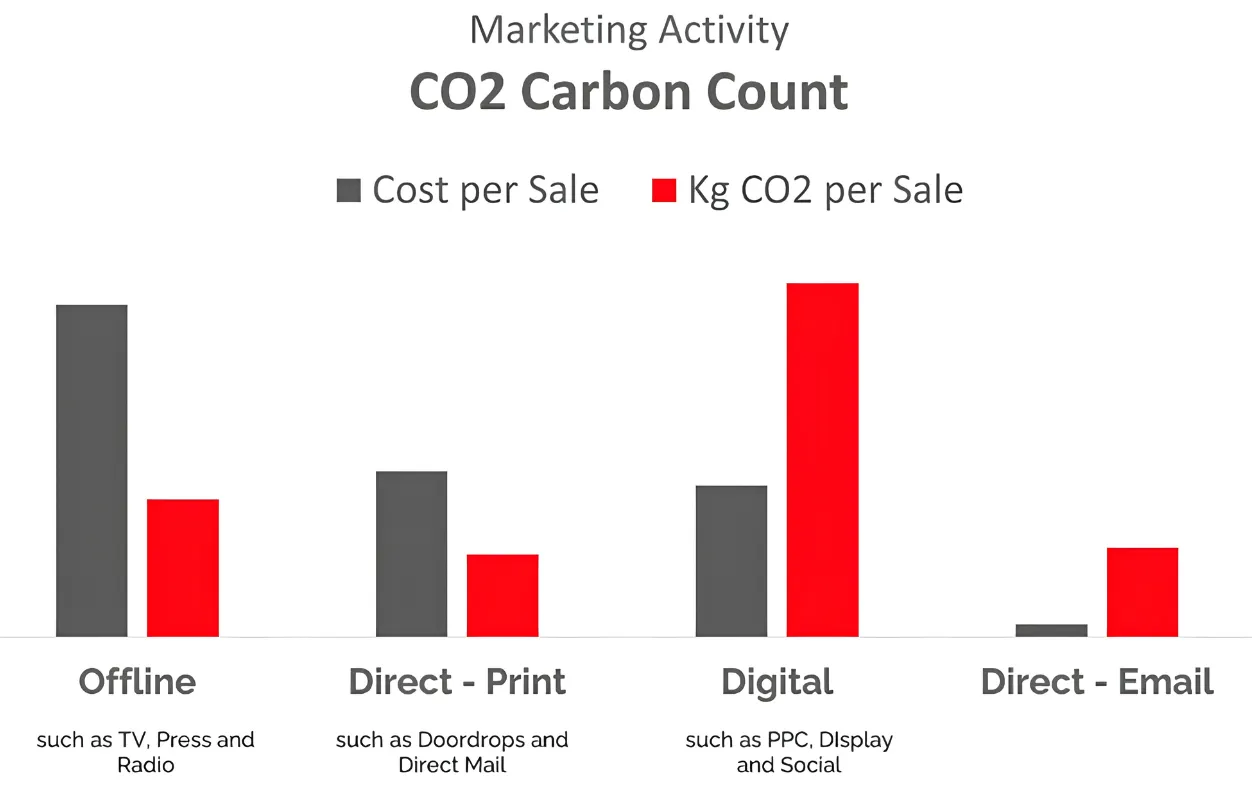
More surprisingly, Brand X’s digital activity’s carbon footprint per sale was much higher than all other channels, driven by the high volume of impressions, PPC bidding and social posts. While some of this carbon footprint of digital came from CO₂ emitted on customer devices and their Wi-Fi, most came from the data centres and vast servers creating, storing and distributing the content.
The study demonstrated that the assumption that digital is the more sustainable option isn’t always true. For Brand X, each sale gained through digital activity generated a very high carbon footprint that exceeded offline activity. It was a clear warning of wasted effort, both in the marketing budget and in carbon.
Source: Jo Young, Managing Director, UniFida