



Sustainable behaviour change: marketing for good

“Don’t think about pink elephants”. People use this statement to demonstrate the power of suggestion, and there are many other ways that we can be persuaded of something. There is a whole science behind techniques that persuade us to buy a product, such as making us believe that stock is scarce1 or that we are getting a great deal2.
These same ideas can be seen in sustainability communication and to encourage sustainable behaviour change. For example, loss aversion3 is a phenomenon by which we feel the pain of a loss twice as intensely as the pleasure of an equal gain. So, one might imagine that a message about how climate change can cost the economy is more impactful than talking about what climate action might save our economy.
Present bias4 is another example where we value immediate rewards over distant ones. Looking at climate again one can see how its impacts often feel decades away, which delays people acting today.
In this blog, we look at three ways behavioural science can be used to create more sustainable mail and how wider efforts to use marketing and behavioural science can create a more sustainable world.
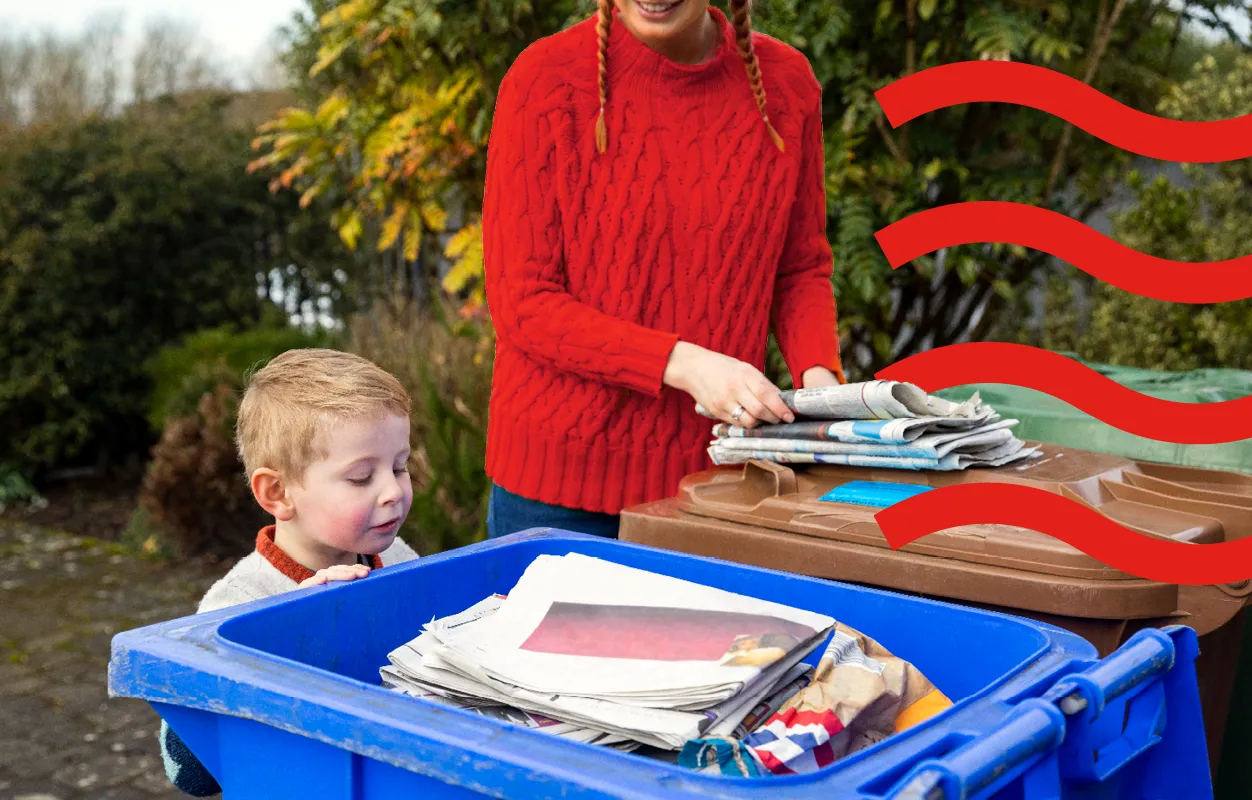
1. Social proof
People tend to follow the actions and choices of others, especially in uncertain situations.
We’ve all witnessed this: when doing the right thing becomes the thing to do. The bar has been raised such that previous behaviours are felt to be outdated and wrong.
We’ve seen this with public campaigns around speeding, wearing a seatbelt or drink driving. We’ve also seen it in the shopping aisle with free range eggs and fairtrade bananas. Marketing undoubtedly has a role to play by setting out rules for consumers to follow.
For mail, there is evidence of social proof where recycling is embedded in the culture as a common circular behaviour. A more nascent behaviour though is repair and reuse. This is where initiatives like PrintGreen have a role to play.
PrintGreen aims to reshape perceptions about print’s environmental impact, address challenges like greenwashing and support carbon reduction efforts. And these efforts rely on social, economic and regulatory pressures too. Over time through collaboration, suppliers across mail’s supply chain will follow one another when circular processes like reuse and repair are standardised and commonplace.
These behaviours can be promoted to consumers, investors and government to create a culture of circularity across the sector. If the social proof for advanced circular processes arises, it generates momentum backed by regulation and industry bodies.
Mail can then be the social proof for other marketing channels and sectors to embrace sustainability and circular processes in their supply chain.

2. Heavy Cognitive Load
There is a limit to learning, governed by the capacity of our working memory. Simple tools reduce this heavy load.
The drawbacks of unsustainable practices can be dramatised and simplified so that consumers make the jump to more sustainable options.
Marketing is great at bringing to life problems and tensions. Some brands, like Oatly5 for example, have done this brilliantly time and again – in their case, highlighting issues like carbon intensity and water usage within the dairy industry in simple ways.
For mail, rather than simplifying the issues that arise from other communications channels, we know there are simple tools that can help change behaviour and create more sustainable mail.
One can easily compare mail that is making effort to be more sustainable and those that aren’t as sustainable through carbon calculation, and anyone can use PrintGreen’s carbon calculator. The carbon comparison between mail that is designed to minimise waste and those that aren’t, is understood by one number. This is an example of what behavioural economists might call ‘hiding the plumbing’ in which complex calculations are run in the background, so users only see the final result. This is an example of releasing cognitive load.
There are also guides like this one and case studies that allow people to make more informed choices in the production of mail campaigns. These guides and tools are effective behaviour change mechanisms. They provide information that people can act on in a format that alleviates cognitive load through simple data and messages.
3. Leveraging reciprocity
Offering something of value in return. Consumers don’t often buy ‘sustainability’ - we don’t buy our yoghurt because it came in a recycled pot or our coffee because the farmer practices regenerative agriculture, despite being good business behaviours.
It is a consideration for some, but usually complementary to taste and cost. However, sustainability can be a pathway to higher quality and lower cost - the things we know consumers value.
Leveraging reciprocity for mail means any reduction in its carbon footprint needs to also provide real value to consumers.
More sustainable mail cannot be a sacrificed to effectiveness or creativity. Making more sustainable choices can reduce resource use and save costs but it can also go hand in hand with creativity. We have written more about this here.
The value that is reciprocated through sustainability can exist as compliance, but it can also align perfectly to metrics that drive core business decisions. Mail that is more targeted, intelligent, efficient, innovative, effective can be achieved through circular thinking and sustainable practices.

Let’s look at the bigger picture.
Behavioural science can have an outsized impact on our economy if it is used to promote sustainable behaviours.
But marketing must also move its entire ecosystem in the same direction. An ecosystem of media owners, producers, insights, creatives and clients each play a role in thinking about sustainable behaviour change. Because when we think about what marketing can achieve it will rely on training schemes, new technologies, different media choices, radical collective thinking. And there is already an organisation thinking deeply on this idea called Purpose Disruptors6.
So, while there is no doubt that tools, guidance and tactics like ‘social proof’ drive sustainable behaviour change, we will need the whole marketing industry to come together to really change behaviour, not just for mail, but for every channel.


