



Supporting a healthy print industry. Aligning commercial goals and sustainable practice.

Let me introduce myself.
I’m Tom Maskill, Chief Client Officer at Webmart1 and Chair of print and mail industry non-profit, PrintGreen.2
PrintGreen is an industry initiative, which aims to provide clear, accessible and accurate insights into the environmental impact of print; enabling brands, agencies, and stakeholders to make informed choices.
From my many years of working in print, I’ve witnessed a common belief that sustainability is a problem to fix. It is often left to a sustainability lead to deal with, but I think that’s a mistake. I know that when an organisation prioritises sustainability across the business, rather than keeping it in silo, it can bring significant competitive advantages – and the print industry is a great example.
A healthy print industry relies on aligning commercial goals to sustainable business practices - making informed decisions based on data and working together to raise standards and improve both the reputation and operations of the whole industry.
This blog looks at what a misalignment between commercial goals and environmental practice costs business and how business can build a strategy for a better long-term future using new tools and support.

We are at a time where environmental standards and sustainability are important.
Consumers are asking businesses to do more to reduce their impact on the environment. Investors and insurers are demanding greater transparency and better corporate governance. Regulations require compliance, and supply chain partners are quickly increasing standards.
And yet, many businesses see sustainability as a sunk cost - an expense that cannot be recovered. But this is misleading as the right sustainability practices can present fantastic opportunities.
Understandably less ink, less paper, improved recycling rates, more efficient van loading, less delivery by plane, renewable power sources and less waste… saves money. Long-term thinking and circularity also build business resilience. And sustainability offers a pathway to innovation.
You can read more about innovation in the print industry in this article by Meeka Walwyn-Lewis, head of marketing and operations for BPIF.
But there is a wider context to sustainable business practice too.
A major poll of UK firms from Ecologi and BusinessGreen3 has already found that a vast majority report facing intensifying impacts from climate change. All businesses going forward should not invite in the risks - both operational and reputational - that come from missing out on efficiency gains, green technologies and a higher purpose.
And the print industry faces some specific challenges, including misconceptions about its environmental footprint. This is despite being one of the most sustainable communication channels. Indeed, the European pulp and paper industry only accounts for 0.8% of European greenhouse gases and it is the biggest single user and producer of renewable energy in the EU.

And yet, research conducted by Two Sides and Censuswide in 2021 found that in the European mailing and postal sector alone, greenwashing threatens the loss of €337m (£292m) of value annually4 to the industry due to declining trust and reduced paper use.
Of course, mail can be a sustainable choice, if you make the right, informed decisions, looking to maximise ROI against carbon emitted. It is ultimately important for the environment and can also drive business resilience and support commercial goals.
CASE STUDY: An example of a sustainable mail campaign is Brown’s Books.
Browns Books, the UK’s leading supplier of books and eBooks for schools and libraries, sends a bi-annual 80+4pp A4 ‘Summer’ catalogue to schools (nursery to university). These printed catalogues are a trusted resource for time-pressed book buyers.
Browns Books partnered with Webmart to radically transform their catalogue production, focusing on sustainability, quality, and cost efficiency.
Using Webmart’s EcoMetrics carbon calculator, they assessed every element of the previous processes and found opportunities to reduce impact without harming the catalogue’s visual appeal.
Key changes included switching to FSC-certified paper and reducing weight from 100gsm to a thicker-feel 90gsm, cutting CO2 by over 10kg. Biodegradable potato starch wraps replaced plastic polywraps, protecting both the environment and the brand’s reputation.
Webmart also cleansed the mailing list to improve targeting, reduce waste, and lower returns. Catalogues were distributed via Webmart’s climate-positive Enviromail service, fully offsetting distribution emissions.
A Carbon Neutral stamp on each catalogue communicated the final CO2e offset for each catalogue, helping to educate the end user on the carbon impact while underscoring Browns’ commitment to transparent reporting and environmental responsibility.
Read more here.
More case studies can also be found here5 on the PrintGreen website and here on the Royal Mail Marketreach website.
PrintGreen is committed to building a more sustainable print industry and helping brands to get the best for both the environment and business with better alignment.
We offer resources to support all organisations in print to understand and mitigate their impact, supporting a healthy print industry and aligning commercial realities to sustainable practice.
- The carbon calculation tool which is free to use on the PrintGreen website6 or through the JICMAIL Discovery tool7 is a great starting point for understanding the industry average emissions for producing a particular print job. Users can then speak with their supply chain for advice on how to effectively mitigate their emissions.
- On our website you can find glossaries8, facts to inform you and guides to support you. We also dispel myths9 and address greenwashing. You can also understand the impacts of digital and print media here.10
- PrintGreen also plan sessions and meetings to bring like-minded people together. We are made up of experts and industry bodies which include Royal Mail Marketreach, Paragon, BPIF, Acorn Web and Whistl - this community is here to help.
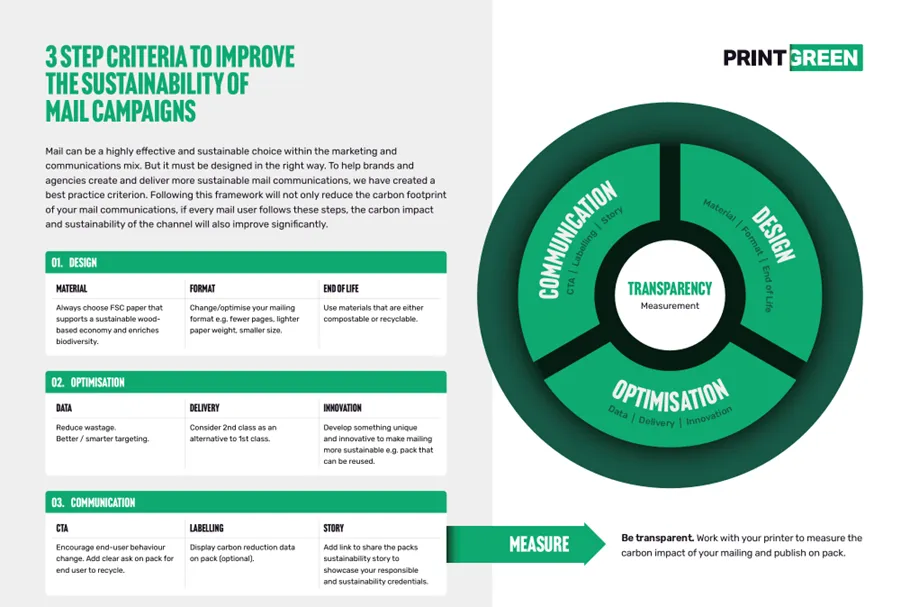
Here is a 3 step criteria to help you improve the sustainability of mail campaigns today:
Through these tools and support, businesses and organisations can make more informed decisions, work together on standards and improve practices across the whole print industry. Getting ahead of regulation, finding efficiencies and fuelling innovation, can create benefits to the bottom line whilst potentially positively impacting the planet.
Examples include optimising print formats to save costs and reduce emissions or smarter targeting to reduce waste and speak only to your target customers. There are many opportunities.
Beyond these efforts, businesses can work together so the impact can be even greater – aligning an entire supply chain to long term sustainable commercial success and proving the channel is future-focused, relevant to tomorrow and responsible.
We hope that sustainability is not confined to one department in a business, but every CEO can see the value in aligning commercial goals with sustainable practices.
You can find out more by visiting PrintGreen.org11


